Introducing new foods when your child has FPIES or food allergies can feel terrifying. You’re torn between wanting to expand their diet and fearing another reaction. A structured, gradual method, often called a ladder approach, can help you move forward in a safer, more confident way.
This guide walks through how to safely introduce new foods, what a ladder approach looks like, and where to find trustworthy resources. Always remember: your child’s allergist or GI should help customize any plan.
What Is the “Ladder” Approach?
The ladder approach is a step-by-step method of introducing foods from lowest-risk forms (well cooked, highly processed, or trace amounts) up to higher-risk forms (less cooked, less processed, or larger amounts).
You’ll see ladders commonly used for:
- Milk (e.g., “milk ladder”)
- Egg (e.g., “egg ladder”)
- Wheat
- Other proteins, in some FPIES or non-IgE protocols
For FPIES, some clinicians also adapt a ladder-style approach for reintroducing previously reactive foods or introducing new but related foods.
Core principles of a ladder:
- Start with the safest form of the food (often baked and in very small amounts).
- Slowly increase dose and/or food form (less cooked / more concentrated).
- Only move to the next step once the previous one is tolerated for a set period.
- Stop and contact your provider if symptoms appear.
Before You Start: Safety Checklist
Before introducing any new or previously reactive food, review these:
- Talk to your child’s allergist or GI.
- Confirm which foods are safe to try at home vs. those that should be done as oral food challenges in a clinic.
- Ask if the ladder approach is appropriate for your child’s specific diagnosis (FPIES, IgE allergy, mixed, or non-allergic intolerance).
- Know your child’s reaction history.
- Timing (immediate vs. delayed)
- Severity (vomiting only vs. shock vs. anaphylaxis)
- Past need for ER, IV fluids, or epinephrine
- Have emergency medications ready.
- For IgE-mediated allergies: epinephrine auto-injector, antihistamines as directed
- For FPIES: your care team’s written action plan (often includes going to ER for persistent vomiting/lethargy)
- Choose a good time.
- When your child is healthy (no fevers, GI bugs, or teething flares that could confuse symptoms)
- When you can observe them for several hours after eating
- When you have help available if needed
- Keep a food and symptom diary.
- Note date, food form, amount, timing, and any symptoms
- This will help your provider adjust the plan and interpret mild or questionable symptoms
Pro Tip: Print this out or save it as a checklist for future use!
How to Use a Ladder Approach Step-by-Step
Below is a generalized framework. Your provider may adjust the pace, doses, or steps.
Step 1: Start with the Lowest-Risk Form
For many allergens, that means:
- Well baked (e.g., muffins, biscuits, cookies baked at high heat for >20 minutes)
- Mixed in a complex matrix (flour, fat, sugar) which can reduce protein reactivity
Example (for a milk or egg ladder):
- A tiny crumb or 1/16 of a baked cupcake containing milk/egg
- Give with a familiar safe food
- Offer once in the morning so you can monitor for several hours
Step 2: Repeat and Observe
If your child tolerates the tiny amount:
- Repeat the same dose several times (e.g., daily or every other day for 3–5 days)
- Watch for both immediate and delayed symptoms:
- Hives, swelling, cough, wheeze (IgE-type)
- Vomiting, diarrhea, lethargy (FPIES-type)
- Feeding refusal, belly pain, behavior changes
If all is well across multiple exposures, move on to the next rung.
Step 3: Slowly Increase the Amount
Increase either:
- The portion size (e.g., from 1/16 of a muffin → 1/8 → 1/4 → 1/2), or
- The frequency (once every few days → daily), as advised by your provider
General rules:
- Only change one variable at a time (amount, frequency, or cooking method).
- Maintain each step long enough to feel confident (often several days to 1–2 weeks per step, depending on history).
Step 4: Progress to Less Processed Forms
Once your child is consistently tolerating well-baked, lower-risk forms:
- Move to moderately cooked forms (e.g., pancakes, waffles, French toast for egg or milk)
- Later, move to lightly cooked or plain forms (e.g., scrambled egg, yogurt), if recommended
Each step up the ladder should be supervised by your healthcare team’s plan and supported by your child’s tolerance history.
Step 5: Know When to Pause
Stop and call your provider (or follow your emergency plan) if you notice:
- Repeated vomiting, pale or floppy appearance
- Hives, facial swelling, breathing changes
- Blood or mucus in stool, persistent diarrhea
- New feeding refusal or clear GI discomfort related to the food
You may need to:
- Go back to the last tolerated rung
- Pause the food for a set period
- Switch to in-clinic challenges for higher-risk forms
Example: Simplified Milk Ladder
Many countries and hospitals use specific, detailed milk ladders. This is just a conceptual example, do not use without medical guidance.
- Heat & Processing: High heat (like baking) and mixing the protein with a “matrix” (like wheat flour) changes the structure of allergenic proteins, making them easier for the immune system to handle.
- Gradual Exposure: You typically start with a tiny amount (e.g., a “crumb” or “pea-size” amount) and increase over several days to a full portion before moving to the next rung.
- Safety First: Ladders should only be started under the guidance of a healthcare professional.. They are primarily intended for children with non-IgE mediated (del
Typical Reintroduction Ladders
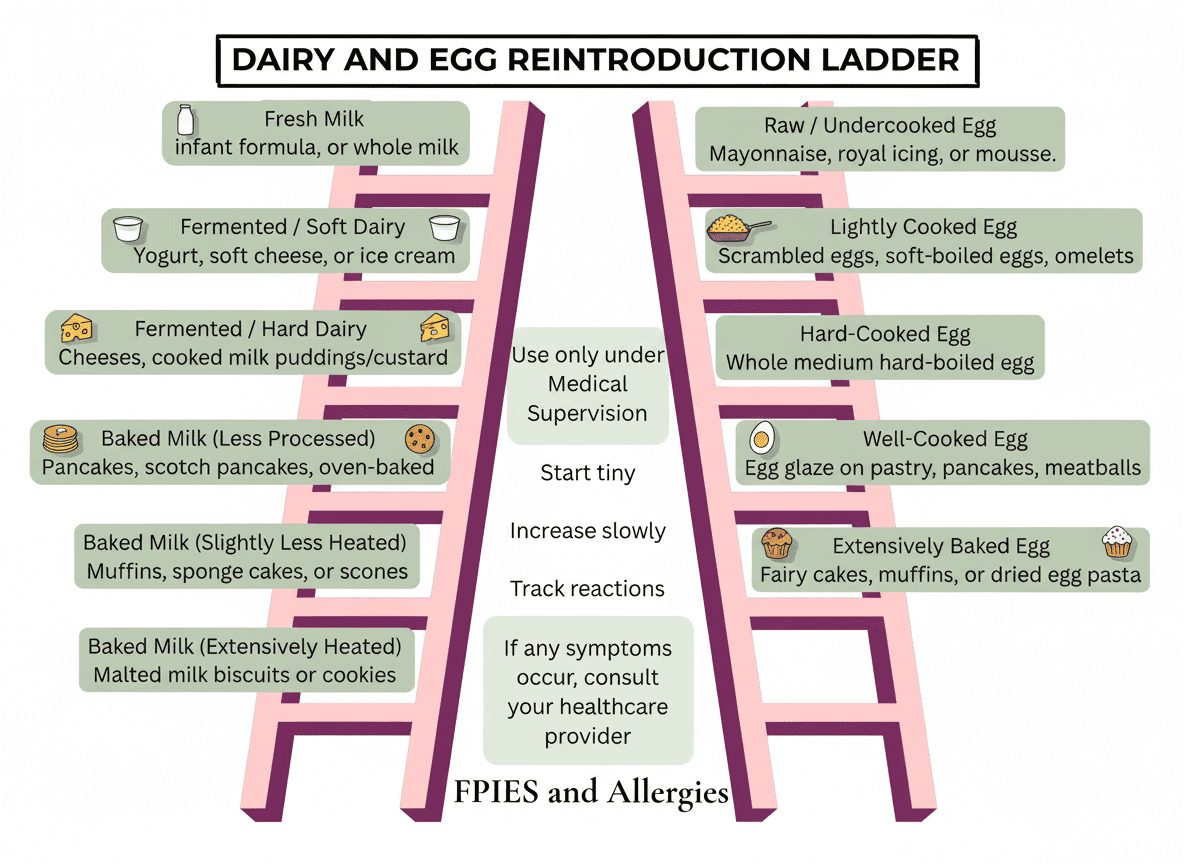
1. Cow’s Milk Ladder (iMAP 6-Step Model)
This is the most common version, often used for infants with Cow’s Milk Protein Allergy (CMPA).
- Step 1: Baked Milk (Extensively Heated) – Malted milk biscuits or cookies.
- Step 2: Baked Milk (Slightly Less Heated) – Muffins, sponge cakes, or scones.
- Step 3: Less Processed Baked Milk – Pancakes, scotch pancakes, or milk cooked in an oven-baked meal (like pizza or lasagne).
- Step 4: Fermented / Hard Dairy – Hard cheeses (like cheddar) or cooked milk puddings/custard.
- Step 5: Fermented / Soft Dairy – Yogurt, fromage frais, soft cheese, or ice cream.
- Step 6: Fresh Milk – Boiled or pasteurized fresh milk, infant formula, or whole milk.
2. Egg Ladder (Typical 5-Step Model)
Used for children with an egg allergy, progressing from baked to raw forms.
- Step 1: Extensively Baked Egg – Fairy cakes, muffins, or dried egg pasta.
- Step 2: Well-Cooked Egg – Egg glaze on pastry, pancakes, or meatballs containing egg.
- Step 3: Hard-Cooked Egg – Whole medium hard-boiled egg.
- Step 4: Lightly Cooked Egg – Scrambled eggs, soft-boiled eggs, or omelets.
- Step 5: Raw / Undercooked Egg – Mayonnaise, royal icing, or mousse.
Key Implementation Guidelines:
- Health Status: Only start when your child is completely well (no fever, teething, or active eczema flare-ups).
- Timing: Start in the morning or early lunch to allow for monitoring throughout the day.
- Progression: Stay on each step for at least 3 to 7 days (sometimes up to 1-3 months) to check for delayed reactions before moving up.
- Reactions: If a reaction occurs, stop and return to the previous successful rung for a period (often 1-3 months) as advised by your doctor.
For more detailed, medically reviewed versions of milk ladders, see:
- British Dietetic Association, Milk Allergy and Reintroduction:
https://www.bda.uk.com/resource/milk-allergy.html - Allergy UK Milk Ladder Overview:
https://www.allergyuk.org/resources/milk-ladder/
For evidence-based egg and dairy ladders, see guidance below:
- Anaphylaxis UK Egg Allergy Guidance:
https://www.anaphylaxis.org.uk/fact-sheet/egg-allergy/ - BSACI (UK) Guidelines (for professionals, but helpful background):
https://www.bsaci.org/guidelines/

Special Considerations for FPIES
For FPIES, the ladder method may look a bit different and must be carefully individualized:
- Triggers and timing differ from IgE allergies; reactions are usually delayed (1–4+ hours).
- Providers may recommend:
- Introducing new foods one at a time, often from “low-risk” food groups
- Longer observation windows after each new food
- Very slow dose increases, sometimes over weeks
- In-hospital oral food challenges (OFCs) for high-risk triggers or previous severe reactions
Helpful FPIES resources:
- International FPIES Association (I-FPIES):
https://www.fpies.org - American Academy of Allergy, Asthma & Immunology (AAAAI) – FPIES overview:
https://www.aaaai.org/tools-for-the-public/conditions-library/allergies/food-protein-induced-enterocolitis-syndrome-fpies
Tips to Make New Food Introduction Less Stressful
- Introduce new foods earlier in the day, not at bedtime.
- Have a calm routine: use the same plate, same chair, safe foods alongside the new item.
- Use measurable amounts (½ teaspoon, 1 teaspoon, etc.) so you can accurately report to your provider.
- Take notes and photos of labels and portions for future reference.
- Support yourself emotionally: this process is anxiety-inducing. Connecting with other parents and allergy communities can help.
Parent and caregiver communities:
- Kids With Food Allergies (KFA) – a division of AAFA:
https://www.kidswithfoodallergies.org - Food Allergy Research & Education (FARE):
https://www.foodallergy.org
When to Ask for an In-Clinic Food Challenge Instead
Ask your allergist if a supervised oral food challenge in a hospital or clinic is safer when:
- Your child has had severe FPIES episodes (shock, repeated ER visits).
- Your child has had anaphylaxis or significant IgE-mediated reactions to that food.
- Allergy blood tests or skin tests show high or unclear sensitization.
- You are extremely anxious and do not feel safe trialing at home.
More on oral food challenges:
- AAAAI: Oral Food Challenges Explained
https://www.aaaai.org/tools-for-the-public/conditions-library/allergies/what-do-patients-and-caregivers-need-to-know-about
Final Thoughts
The ladder approach can provide structure and a sense of control in a very scary process, but it is never one-size-fits-all. The right ladder, pace, and starting point depend on your child’s exact diagnosis, history, and test results.
Use ladders as a framework, but always in partnership with your child’s healthcare team.
Important Disclaimer
This blog post is for educational and informational purposes only and is not a substitute for professional medical advice, diagnosis, or treatment. Do not start, stop, or change any food introduction, ladder, or reintroduction plan based on this article alone. Always consult your child’s allergist, pediatrician, or other qualified healthcare provider before introducing new foods or retrying previously reactive foods, and follow their specific recommendations and emergency plan.

Leave a Reply